Filmpocalypse
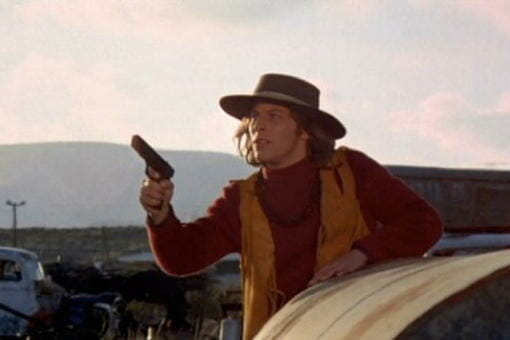
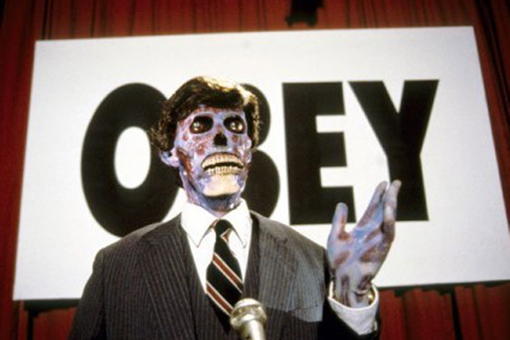
#12: They Live
Written by Brock Wilbur Wednesday, April 04, 2012, 11:16 AM

"Wearin' these glasses makes you high, but, oh, you come down hard."
Let's talk consumerism.
I have shelves of DVDs that occupy an entire wall of my house. Bookshelves cover most everything else, except a corner controlled by Xbox 360 games. I maintain an Amazon Prime account, so when I want more of these products, they'll arrive slightly faster. I even use an Amazon Wishlist, so that I can remember all the things I want, should I forget how important their acquisition will be to my happiness, and I can share with both friends and strangers (if they're tactless enough), so they'll know how to show me love.
#11: The Happening
Written by Brock Wilbur Thursday, March 22, 2012, 10:54 AM

M. Night's movie about a sinister force that makes us want to kill ourselves — and it it's not the plants.
I used to thinkI had friends.
I thought I had a support system in place. People who cared about me. Who believed in me. Fellow travelers through this life who had my back as I had theirs. You guys knew I had defended Lady in the Water as an intentional comedy that was misunderstood by the public, and one of Paul Giamatti's best roles (opposite a film critic that gets murdered and M. Night Shyamalan playing the visionary who has come to save the world). You also knew I loved terrible things, and making drinking games out of cinematic sadness. It is why you all called me "friend."
Why did you allow me to go this long without seeing The Happening?
#10: Last Night
Written by Brock Wilbur Thursday, March 08, 2012, 10:07 AM

Is ignorance bliss, or is it just a different joy than knowing?
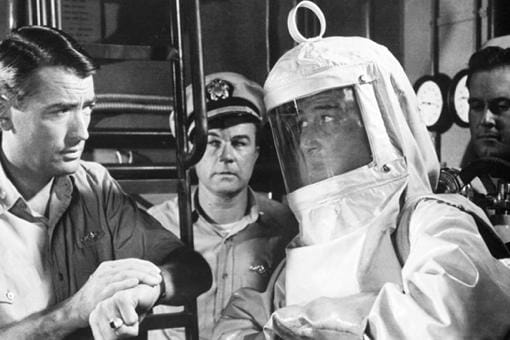
Except in extreme medical scenarios, people remain uncertain of their time remaining on Earth. Films like 50/50 can explore how individuals handle this reversal, and sci-fi dabbles in it with works like In Time, but in both, examples a major part of the arc is the protagonist's attempts to alter their fate. What happens when you are given both the ticking clock and the unwavering certainty of its grim resolution? Moreover, what does the scenario look like when played out across a family, a city, or a world?
Is it better to be side-swiped, or to see the end coming from a mile away?
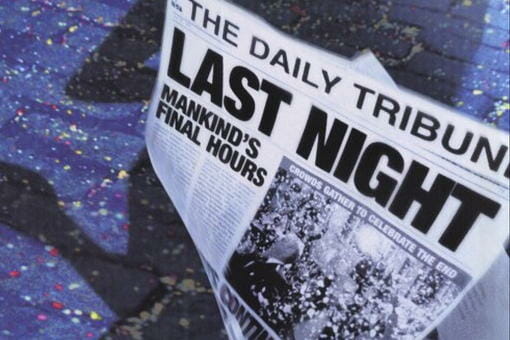
In 1998, Don McKellar wrote, directed, and starred in Last Night, a film with a stunningly optimistic, yet honest, approach to a worldwide apocalyptic event. With a few exceptions, it's mostly a small character piece that treats the end of days as background to the lives in its focus, and how our psyches would respond to knowing the unknowable.

Everyone on the planet has known for three weeks that the world is coming to an end. It is never specified how, but the end is coming at midnight, and it is extremely bright out, so I'll wager the sun is involved. We join Toronto at 7pm on this last night, to watch the narrative of humanity resolve.
Depressed widower Patrick (McKellar) visits his family, including his remaining grandparents, his younger sister (Sarah Polley) and her boyfriend. His mother has unpacked all the boxes of their childhood memorabilia, and treats this final night like Christmas morning. Despite that bit of delusion, the rest of the event transpires with normal family politics, hyperfocusing on the minutiae and wondering why Patrick hasn't met a new girl.
The manager of the power company (David Cronenberg, acting?) makes it his personal duty to call every customer and remind them the gas will be kept on right up to the end. His assistant Donna (Tracy Wright) is in love with him, but unable to make a move, even now. After his departure, she uses the company computer to begin online dating, although hopefully not looking for a long-term relationship.
Sandra (Sandra Oh, doing the best work she's ever done) is trying to make her way home when a roving street gang flips her car. Elsewhere, Craig (Callum Keith Rennie) has been using these last weeks to guarantee he doesn't die without experiencing every single sexual encounter he's ever fantasized about, including hooking up with one of his former teachers. Arsinee Khanjian plays a mad woman, sprinting through the streets and ticking down the minutes.
In this world, the panic simply does not exist, since one would seem mad to be upset about an event you've had weeks to prepare for. Instead, the city seems almost serene. A celebration has overtaken the urban centers, and while minor acts of vandalism and violence do occur, isn't that true of all good parties? The fascination lies in determining who will use this time to live as they've never lived before, and what that looks like on an individual basis, versus those like Cronenberg, whose only desire is to live out another normal day. This dichotomy becomes one of the best scenes in the film, where Craig tries to convince his long-time friend Patrick to be his one homosexual experience, but Patrick still has errands to run.

Patrick and Sandra cross paths, and she enlists his help in locating her husband, who is not returning calls. After failing to find usable transportation, they resign to the fact it would be impossible for her to reach him before the final moments. Instead, Sandra begs to share the end with Patrick, but wants to fall in love with him first, so the two begin a tear-soaked first date, which races towards the repressed truths in the center of their hearts, hoping they'll force that beautiful connection before existence is unmade. In the midst of this, Patrick's parents call, and are thrilled to hear he's finally found a girl.
There's a small sequence in which Patrick's grandparents watch the end coming. One of them feels pity for the youth who have been cut off too soon. The other fires back, asserting that it is the elderly who are technically losing the most, and that while kids are missing out, people of her age are unable to finish the works of a lifetime, and everyone is wasting their time when the rush to defend children. Honesty born of egotism that may ring true, but would be socially unacceptable in any scenario except the total finale.
It's that sublime comedy which permeates even the darkest interactions of Last Night, but it only works because the end has been applied to all of us equally. Patrick recounts how the love of his life got sick and died, just before they announced the world was going to end, and how painful that seemed, back when people died one by one. Maybe the hardest thing to accept about death is not the finality, but the loneliness. And in that way, global Armageddon is the most joyous experience we can hope for.
#9: Pontypool
Written by Brock Wilbur Thursday, March 08, 2012, 10:04 AM

"It's not the end of the world. It's just the end of the day."
The Devil's in the details, but what's between the lines?
In 2001, Dilbert creator Scott Adams penned a small novella entitled God's Debris: A Thought Experiment. This pocket-sized volume never shook the foundations of the theological community, but it resonated deeply with me, if only as an introduction to Socratic discourse. The narrative concerns a lonely man visited by an "angel" who engages him in conversation about the nature of God, human interaction vs. purpose, and destiny. The take-away concept was that an all-powerful being would get bored of having total control of the universe, but what if he made himself a lesser, yet more intriguing, force? What if God existed as probability? Popping in and out of existence; moving the universe towards a goal but on an uncertain path, exerting will in unknowable yet noticeable ways?
The opening monologue of Bruce McDonald's Pontypool (2008) references a similar theory by Norman Mailer: "In the wake of huge events, after them and before them, physical details, they spasm for a moment; they sort of unlock, and when they come back into focus, they suddenly coincide in a weird way. Street names and birthdates and middle names, all kind of superfluous things appear related to each other. It's a ripple effect. So, what does it mean? Well... it means something's going to happen. Something big. But then, something's always about to happen."
Both of these notions side equally with the idea that the unknowable "beneath" is more powerful than overt control, and that the great mystery of life may also be the purpose of life. But is the reverse true? If so, does understanding equate to death?
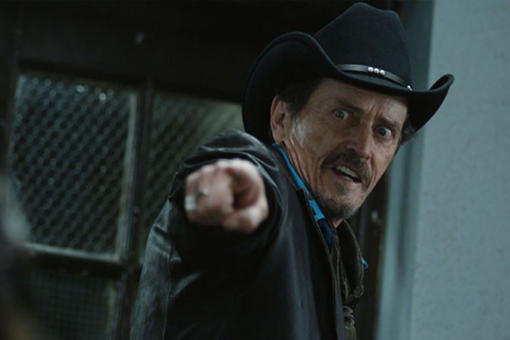
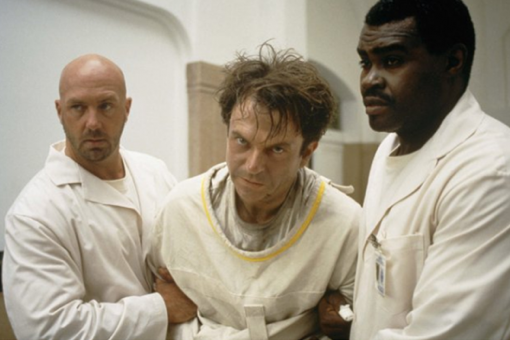
Shock jock Grant Mazzy (Stephen McHattie) isn't the man he used to be. Fallen from grace — as far as a professional inciter can — he's been reassigned to morning radio duties in the small Ontario town of Pontypool. Within a converted church basement, he broadcasts school closures and obits, fueled by resentment, boredom, and whiskey. He's a hero to a starry-eyed engineer, Laurel Ann-Drummond (Georgina Reilly), and a nuance to be wrangled by producer Sydney Briar (Lisa Houle).
For the first fifteen minutes, Mazzy treats the airwaves like a crayon-wielding toddler meeting fresh wallpaper. He bastardizes and re-imagines the news of import into tales of violence and intrigue, daring his listeners to voice their opposition and turning the members of his production staff against each other. He recounts his morning commute, and an odd experience with a woman who approached him, then communicates with Sunshine Ken in their news chopper (Ken actually sits on a hill, making helicopter sound effects).
The entire morning segment is daft wordplay, overlapping into nonsense and drifting further from conceptual reality, but also grounding us in the filmic world and our location. Pontypool feels more like a college theater production than a feature film: the three characters, the static setting, the wordiness and inconsistent tone... even the lack of variation among camera angles. There is an unknowable Other in the world outside, but we're safe because we'll never move; and the outside won't be invited in. There's just no space for it. Or budget. Whatever the rules are that we communally accept.
For a town where nothing ever happens, Pontypool begins to deliver excitement for Mazzy, even if he can't stop exaggerating. Two drunk ice fishermen on the road are accidentally reported as a hostage situation, and the DJ can't go without accusing the police officers involved of also being drunk. A family band, scheduled as morning entertainment, appears from nowhere. Mazzy calls his old manager to let him listen to these... don't know what to call this. If you put on blackface for a minstrel show, what do you call white people performing, dressed as Arabs? It's more bewildering than offensive, until the youngest girl breaks down. She's unable to remember a specific word, and just begins spouting off repetitive nonsense. It sounds silly, and Mazzy treats it as such, but it's also uncanny enough to get under your skin.

That's when the reports begin pouring in. Inexplicable violence. Cannibalism. A local doctor's facility overrun by fanatical mob. Explosions. Military vehicles. Quarantine. Mazzy tries to decipher the phone calls they receive, only to be shoved on to the next by Sydney, who doesn't want unsubstantiated rumors broadcast on the air.
It's beautiful to behold, and a testament to the acting and filmmaking (and especially sound department/V.O. actors), just how powerful these sequences become. Hearkening back to the days of radio tension, and borrowing just enough from the infamous War of the Worlds broadcast, the descriptions from survivors and our involvement in their journey through the Other comes back to us via the terrible toll it takes on Mazzy, personally. By the time he snaps, the true madness has already spread to Laurel Ann, and now the Other is inside.
Pontypoolgoes from odd-but-clever indie-horror at this point to pure sardonic genius. I've never felt like including a SPOILER ALERT in Filmpocalypse before, but today's the day:
While a near-textbook Zombie apocalypse is overtaking the town, and drawing the Mad towards the radio station, Mazzy and Sydney attempt to decipher how the disease is spreading, and what it's doing to Laurel Ann. Between a few bizarre external influences, it is revealed the disease exists in words. Not all words, and not all the time. Terms of endearment, phrases that conflict, and so forth. But more importantly, it only transfers through the English language.
A linguistic-based zombie Armageddon. We've traded brain-eating for semiotics.

The level of violence compensates for this academic approach: what happens to a human body when it fails to transfer the infection is... splattery, to say the least. But the narrative situation of a man who prattles on endlessly about nothingness, faced with an obligation to share his findings in hope of saving the world, but also in danger of destroying via the same action? Priceless. Mazzy has spent his life twisting subtle truths into nonsensical jumbles, and humanity's last hope is his ability to re-arrange the building blocks of our brain patterns, and sell it to us with gusto.
He has becomes both God and probability, existing at the whim of his tools.
Pontypoolstructures itself perfectly around the opening premise. Small details align to create big events in our world, but knowing which details will be bullets is impossible until after the gun has already fired. And more importantly, how are we to determine reality in a society driven by those who drift from it? Does communication build us toward anything, or are we at the mercy of an inevitable end that none of us can define? What if we're in a game where knowing the rules means you lose?
Don't understand?
Excellent.

#8: Blindness
Written by Brock Wilbur Thursday, March 01, 2012, 1:42 PM

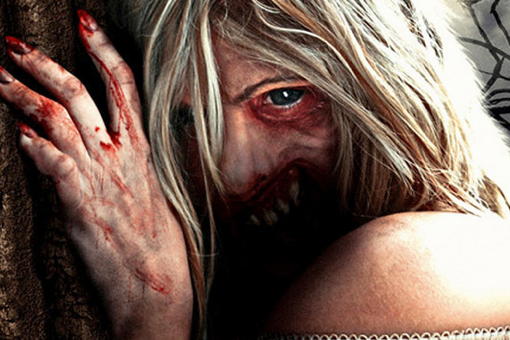
The entire planet loses its sight in a sweeping plague of white blindness — the story of an Apocalypse within.
More than death, cosmic horror, or the darkness, we fear our own frailty.
Sure, warheads raining nuclear annihilation upon our cities and melting the flesh from our skeletons is not preferable, but as we talked about with On The Beach, isn't it much worse to know you've been made into grilled cheese because two bureaucrats you never met couldn't get along? The frailty of society is the basis for so many great films, because unlike aliens or zombies, it isn't a concern the general population actively grapples with on a daily basis. Unless you're me. But I'm the outlier.
More Articles...
Page 1 of 3
«StartPrev123NextEnd»Latest Features
- Hawke, Delpy & Linklater talk Before Midnight
- What Maisie Knew: Directors Scott McGehee and David Siegel
- PJ Boudousque: Coldwater, Little Rock Film Fest
- Writer/Director Vincent Grashaw: Little Rock Film Fest
- Top 10 Best Gangster Films
- Top 10 Family Friendly Not-So-Scary Movies
- Frances Ha: Writer / Director Noah Baumbach
Latest Reviews
Get Free Screenwriting Tips from TSL
Latest Features
Latest Reviews
How to write a screenplay
Five Plot Point Breakdowns
Despicable Me (2010)
Write for the The Script Lab
Want to write for The Script Lab reviewing of discussing TV, Film, Books or Software?. Send a writing sample and what you're interested in covering to writefor@thescriptlab.com