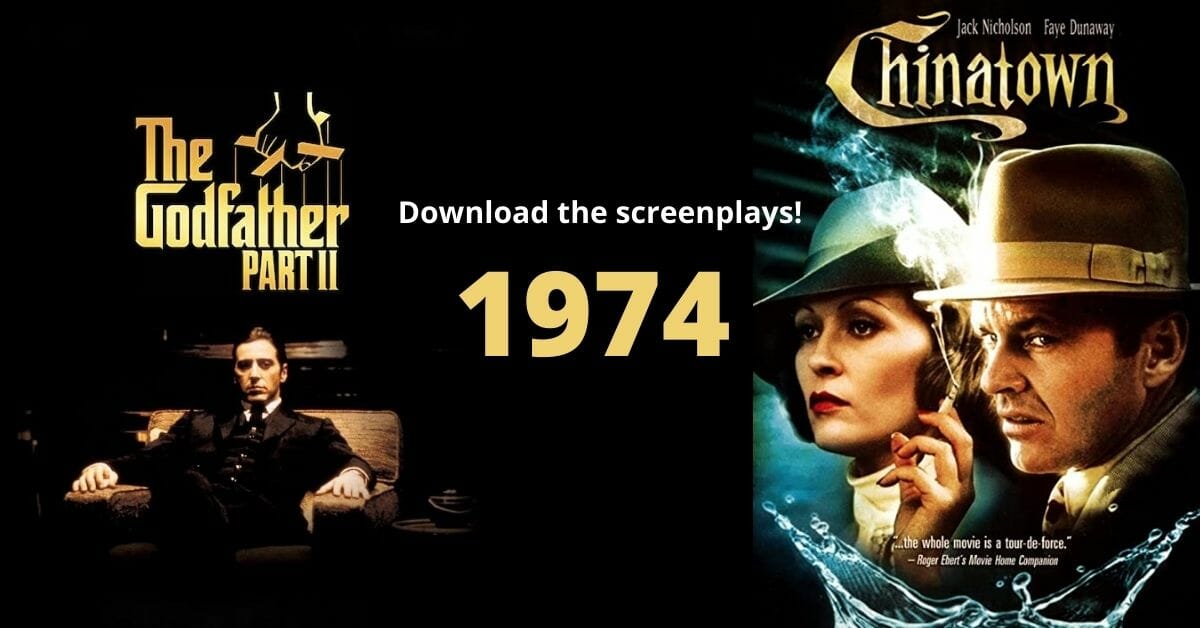
The Script Lab's contributor Martin Keady explores one of the greatest years in screenwriting history. Links to free screenplay downloads…
Read More
Screenplay
It's funny what a person remembers: crying in my cinder block basement after my sixth grade girlfriend dumped me, only to be fully recovered a few hours later while reaching the coveted eighth world of Super Mario Brothers, smugly saluting a local news crew while competing in the 1987 National Lego Competition at FAO Schwarz on 5th Avenue, or leaving my college dorm room in tears and sprinting to the shores of Lake Michigan to literally vomit in grief over the death of my childhood dog, poor old Flash.
You might be wondering what a few personal moments of rejection, hubris, and loss have to do with screenwriting? Well, I'd like to think everything.
We've all been there at one point. You’ve written your screenplay, you think is simply amazing. You proudly show it to someone, only to be told it’s a complete mess: "The structure is all wrong", "There’s no story", "People don't talk like that", "I don’t care about the main character", "The tone is all over the place", or even the ubiquitous "Don't quit your day job."
The truth is that the construction of a good screenplay is something quite complicated and difficult. Atmosphere, tension, characters, conflict, theme, tone, sequences, rhythm, plot, mood, dialogue, form, twists, scenes, style, polarity, culmination, and action all must be materialized into words and sentences that make up a coherent screenplay. Most importantly, that screenplay needs to elicit the same emotional impact that your sixth grade girlfriend did, while you were sobbing on your basement floor.
Ingmar Bergman probably explained screenwriting best: "This is an almost impossible task."
But it is possible. And with a lot of hard work and a little help, anyone can write a screenplay – a great screenplay. It sure as hell ain't easy, but you can do it.
The category sections and articles that follow are all of the tips and tricks of the trade I've learned from my years as a working screenwriter and Cinema Arts professor. So pull up a chair, roll up your sleeves and dive in. If you've written a few scripts, but you're looking for some help on structure, use the menus on the top and left to get right to the meat. If you’re a beginner, start from, well… the beginning.
Good Luck, and start screenwriting!